
CarrierWin vs RigBooks: Beyond Cost Per Mile
CarrierWin and RigBooks both speak trucking — no translation needed. RigBooks has spent over a decade as the low-cost bookkeeper for independent operators, built around cost per mile and IFTA. CarrierWin is trucking math, built from inside a trucking business, to answer one question loud and clear: which trucks and which loads are actually making you money?
RigBooks is the tool that organizes your books. CarrierWin is the tool that reads your margins. Here’s the honest, head-to-head.
The Core Difference
Give RigBooks credit — it’s the real deal for what it is. It’s cheap, it’s simple, and it’s tailored specifically to truckers: cost per mile, profit per mile, fuel purchases, IFTA returns, and tax reports you can hand to an accountant. Thousands of independent operators and fleet managers run their bookkeeping on it.
But here’s the question RigBooks was never designed to answer in one click:
- Which of my trucks is profitable right now — not last month, right now?
- Is this specific load worth taking at this rate, graded against my actual costs?
- What’s each truck’s running balance, including the debt a bad week quietly racks up?
- Which driver or truck is quietly eating my margins?
RigBooks can print you reports to hunt for those answers. CarrierWin just hands them to you. To get your true number in the first place, our step-by-step guide to calculating cost per mile in trucking and our cost per mile calculator walkthrough for small fleets are good starting points.
RigBooks’ Real Role in a Trucking Business
Let’s be fair. RigBooks is a legitimate, affordable, and genuinely useful tool for:
- Cost per mile & profit per mile — its core strength, with a dashboard showing both at a glance
- Trip & load tracking — multiple drops and pickups, paid/unpaid miles, shipper and consignee details
- Fuel purchase tracking — odometer-based mileage and cost per gallon, per fill-up or by date range
- IFTA reporting — miles per jurisdiction with automated calculations for your return
- Invoicing — instant invoices from trip records, with aging, partial payments, and unpaid views
- Expense tracking — categories, subcategories, receipt attachments, recurring expense scheduler
- Maintenance & equipment records — PM tracking for trucks and trailers
- Driver settlements — pay by the mile, load percentage, or flat rate per trip
- Tax reports — P&L, expense, and fuel mileage reports to hand your accountant
RigBooks is legitimate and plenty of operations run it well. We’re not here to trash a good, cheap tool. We’re here to point at the gap you can’t afford to leave open: RigBooks organizes your books, but it leaves the profit math to you. That gap is what CarrierWin closes.
Where RigBooks Falls Short for Profitability
RigBooks is strong where it is. But on the financial side, it stops short of answering the questions that actually decide whether you stay in business:
-
No automatic per-load grading
RigBooks reports cost per mile and profit per mile so you can pick better loads. But it doesn’t grade every single load green, yellow, or red against your real operating costs, automatically, before you commit. It hands you reports to build the picture on; our manual load math vs instant break-even post shows the difference that makes.
-
No running per-truck debt
RigBooks tracks costs and revenue by truck. It doesn’t carry a cumulative profit and debt balance that updates with every load — so a string of tight loads can quietly pile up before you notice.
-
No fuel card dedup
Fuel purchases go in by hand and get tracked by odometer. There’s no automatic fuel card upload parsing, and no built-in catch for duplicate transactions sneaking into your numbers.
-
No load-conflict safety net
RigBooks tracks trips and loads. It won’t stop two different loads from fighting over the same truck at the same time — that’s on your dispatcher to catch.
What CarrierWin Adds
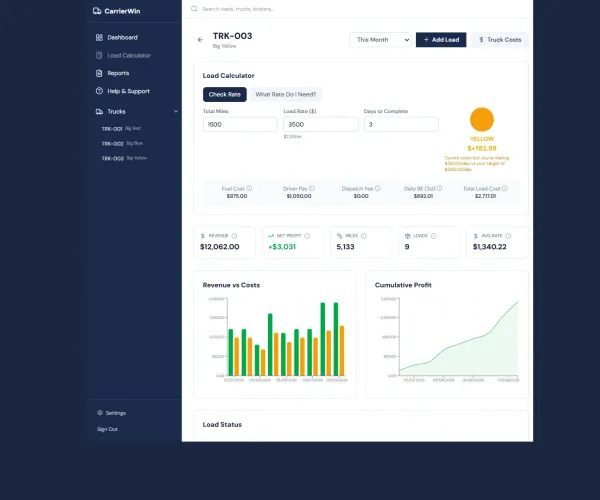
CarrierWin closes the gap between “my books are kept” and “my business is actually profitable”:
- Per-truck profit & debt — every load updates each truck’s cumulative profit automatically. See exactly where you stand, per truck, every single day.
- Load calculator — grade any load green, yellow, or red against your real operating costs before you commit.
- Load conflict correction — the moment two loads collide on the same truck, CarrierWin flags it and helps you fix it. No overlapping loads slipping through.
- Fuel dedup & parsing — upload your fuel card, let CarrierWin parse it, and rest easy knowing duplicates get caught automatically. No more double-counted fuel.
- Company cost allocation — overhead spread across the fleet to reveal each truck’s true break-even.
- IFTA state-by-state reporting — miles broken down by state, per quarter, tied to your actual per-load routes.
- Driver pay built in — percentage, per-mile, or daily pay calculated straight off real loads. Pay your drivers right, every time.
Fair Credit: Where RigBooks Shines
An honest comparison shouldn’t pretend RigBooks is weak where it’s actually strong. If any of these are must-haves, RigBooks earns its keep:
- Cost per mile & profit per mile — simple, affordable, tailored to independent operators
- Fuel tracking — odometer-based mileage and cost per gallon
- IFTA returns — miles per jurisdiction with automated calculations
- Invoicing — instant invoices from trip records, with aging and unpaid views
- Maintenance & equipment records — easy PM tracking for trucks and trailers
- Tax reports — clean P&L and expense reports for your accountant
If affordable bookkeeping, invoicing, and maintenance records are your must-haves, RigBooks can handle those. But that only covers the bookkeeping side. RigBooks is built for the part of the picture you can see; CarrierWin is built for the part that actually decides your margin — the per-truck and per-load profit intelligence no bookkeeping tool gives you.
Which Should You Choose?
The short answer: you need CarrierWin for your profitability.
RigBooks will happily keep your cost-per-mile, IFTA, and expense books organized — keep it for that if it’s working. That’s what it’s for. But here’s the part you can’t skip: RigBooks was never built to tell you, every single day, which trucks and loads are actually making money. That’s a decision-making gap no report RigBooks prints will close for you.
That gap is exactly what CarrierWin exists to fill:
- Per-truck profit & debt you see today, not after you rebuild a spreadsheet
- Every load graded against your real costs before you commit to it
- Fuel dedup and load conflicts caught automatically, so bad numbers never quietly sink a truck
If you’re running RigBooks, run it for the bookkeeping. But if your goal is knowing which trucks earn and which ones bleed — and acting on it — CarrierWin is the tool you need, not the one you have to talk yourself into.
Don’t keep reconstructing your own numbers. Let CarrierWin hand you the answer.
See your real truck-level profit — the part RigBooks leaves out
RigBooks keeps your books. CarrierWin reads your margins. Stop guessing which trucks make money and which ones quietly bleed you dry.
| Feature | CarrierWin | RigBooks |
|---|---|---|
| Per-truck cumulative profit & debt tracking | ✓ | ✗ |
| Automatic per-load break-even & profit grading | ✓ | ✗ |
| Automatic load conflict detection & correction | ✓ | ✗ |
| Automatic fuel card upload parsing & dedup | ✓ | ✗ |
| Company overhead allocated into per-truck break-even | ✓ | ✗ |
| IFTA state-by-state reporting | ✓ | ✓ |
| Cost-per-mile & profit-per-mile reporting | ✓ | ✓ |
| Driver pay calculated from real loads | ✓ | ✓ |
| Invoicing & accounts receivable tracking | ✗ | ✓ |
| Equipment & maintenance records | ✗ | ✓ |
Is CarrierWin a replacement for RigBooks?
RigBooks is a solid, affordable bookkeeper for cost per mile and IFTA. But it was never built to answer the question that actually keeps you in business: exactly which trucks and loads are making money, and where the leaks are. That's the part CarrierWin is built for. Whatever else you run, CarrierWin is the profitability layer you shouldn't go without.
Doesn't RigBooks already track cost per mile and profit per mile?
It does — that's its strength. RigBooks reports cost per mile and profit per mile as averages you can use to pick loads. But it doesn't auto-grade each load green, yellow, or red against your real operating costs, and it doesn't carry a running cumulative profit and debt balance per truck the way CarrierWin does. RigBooks gives you reports to build the picture. CarrierWin hands you the picture.
Should I use CarrierWin or RigBooks?
For cheap cost-per-mile and IFTA bookkeeping with invoicing and maintenance records, RigBooks is a fine, affordable option. But if your goal is automated per-load profitability, load conflict correction, fuel dedup, and per-truck debt tracking, CarrierWin is built for that. For trucking-specific profit intelligence, CarrierWin gives you the answer without reconstructing it yourself.
Ready to stop guessing which truck is making you money?
Stop hauling loads that are sinking you. Know before you book.